Buying a commercial EV charger looks easy on paper, until you start comparing them You will see different power ratings, connector options, AC and DC models, software features and installation requirements. The confusing part is that the charger with the biggest number on the specification sheet may not be the right one for your property.
A better way to purchase a commercial EV charger is to start with the spot where it will be used . How long do vehicles stay there? How many vehicles can be expected to charge?Do drivers need a quick top-up or several hours of charging? Can the building handle the power it needs? Those questions will tell you much more than the charger price alone.
First Look at the Parking Not the Charger
Think about a normal day at your property. An office might have most cars arriving around 9 AM and leaving around 6 PM. A hotel guest could leave a vehicle overnight. A restaurant customer may stay for less than an hour. A fleet vehicle might return to its depot with a fixed schedule and need to be ready again before the next trip. These are completely different charging situations. This makes vehicle traffic patterns the true baseline for planning business EV charging, instead of the equipment sold on the market
What different locations may need
| Site | Standard | Things you might need to consider |
| Office | Cars remain parked for hours | AC charging and the volume of parking users |
| Hotel | Overnight and short-term guests | Convenience and mixed charging needs |
| Mall | Frequent turnover of vehicles | Charging availability and user experience |
| Restaurant | Relatively short visits | Whether charging adds value during the visit |
| Petrol pump | Drivers want to continue their journey | Faster charging and turnaround |
| Fleet depot | Several vehicles follow operating schedules | Number of charging points and load management |
| Highway location | Travellers generally have limited time | Higher-power charging requirements |
These are starting points not fixed rules. A hotel with a large fleet partnership may need something very different from a small hotel with occasional EV guests.
Step- 1 Figure Out How Long a Vehicle Will Actually Be Parked
Charging power only matters in relation to time. Suppose an employee arrives at 9 AM and leaves at 6 PM. The vehicle has several hours sitting in the same parking space. Now compare that with a driver who stops for 30 minutes. Giving both locations the same charger simply because they have similar numbers of EV users would not necessarily make sense. For longer stays, an AC charger can have enough time to add useful energy without requiring extremely high power. For shorter stops, faster charging may be more valuable. So before selecting a commercial EV charger, note down how long vehicles typically stay parked. A simple estimate begins with
Number of vehicles × average parking time × expected charging requirement
It will not give you a final engineering design, but it can help you understand the scale of the charging demand. For longer stays, explore our AC charging solutions for efficient charging while vehicles remain parked.
Step- 2 Estimate How Many Cars Will Need Charging at Once
Daily EV numbers are useful but they do not tell the whole story. Just as important is the time those vehicles will need the charger. Imagine a company has 20 EVs using its premises during the day. If they come and go at different times the charging load may be spread out during the day. Now imagine those same 20 vehicles are part of a delivery fleet and most return between 5 PM and 7 PM. Suddenly the charging requirement looks very different. When planning commercial EV charging infrastructure look at:
- Average EVs arriving each day
- Peak arrival and departure times
- Number of vehicles needing charging together
- Average energy required per vehicle
- How long vehicles can remain connected
- Whether the number of EVs is projected to increase
This is where a simple usage log can be surprisingly useful. If your business already has EV users, look at their actual parking and charging pattern instead of relying entirely on assumptions.
Step- 3 Decide Whether AC, DC or Both Make Sense
The AC-versus-DC question is usually discussed as if one is automatically better. It isn’t. They solve different problems.
When AC can make sense
AC charging works well when vehicles have enough time to remain parked
Examples include:
- Employee parking
- Hotels
- Offices
- Long-stay commercial parking
- Some residential-commercial developments
The vehicle uses its onboard charging system to convert the supplied AC electricity for battery charging. Learn more about EV charging specifications Bee EV Charging
When DC can make sense
DC fast charging becomes more relevant when reducing charging time is an important part of the business model.
It can suit locations such as:
- Highway charging sites
- Fleet operations
- High-turnover public charging
- Petrol pumps
- Commercial locations where customers cannot stay for long
BEE’s published charging specifications include categories such as Type-2 AC and CCS fast charging with specified power ranges and vehicle applications.
The important point is this:
Don’t choose DC simply because it is faster. Choose it when the location has a real reason to need faster charging. A high-power charger sitting mostly unused is not necessarily a smarter investment.
Step- 4 Match the Charger to the Vehicles
This is one part of charger selection that is easy to overlook. Before buying equipment find out what vehicles are expected to use the station.
You should know:
- Which vehicle types will use it
- If they require charging via AC or DC
- What connector they support
- Their maximum charging capability
- Whether different vehicle types will share the same station
- Whether the charging setup needs adapters or additional equipment
BEE’s EV FAQ defines EVSE as the external charging equipment connecting an EV to a power source and notes that EVSE can include functions such as smart metering and network connectivity. That matters because a charger is not useful simply because it has a high output rating. The vehicle also needs to be capable of using that output. For example, installing a very high-power charger for a group of vehicles that cannot take advantage of that power can leave part of the investment underused.
Step- 5 Don’t Choose Charging Power From the Product Name Alone
This is where the specification sheet needs a closer look. A charger may be advertised as a particular kW rating. That tells you what the equipment can provide under the relevant operating conditions. It does not automatically tell you what every vehicle will receive.
Think about three separate limits:
Charger limit
How much power the charging equipment can deliver.
Vehicle limit
How much power the vehicle can accept.
Property limit
How much electrical power the site can safely make available. The practical charging result is affected by all three.
BEE’s published specifications, for example, list CCS fast charging at a minimum 50 kW and Type-2 AC at a minimum 22 kW within the referenced charging categories. That information is useful when understanding charger categories, but a business still needs to check its own vehicles and site before selecting a product.
A Simple Example
Suppose a commercial building has:
- 30 parking spaces
- 8 regular EV users
- Vehicles parked for 7–8 hours
- Only 2–3 users likely to charge at the same time
That site may have a very different requirement from a highway location with drivers arriving specifically because they need a quick charge. The number of parking spaces alone doesn’t tell you which charger to buy. The way those spaces are used does.
What You Should Know Before Moving to Installation
At the end of this stage you should be able to answer:
- Who will use the chargers?
- How long will vehicles remain parked?
- How many vehicles may charge simultaneously?
- What type of vehicles are expected?
- Do they need AC, DC or both?
- How much charging power can those vehicles use?
- What electrical capacity is available at the site?
If you cannot answer these questions yet it is probably too early to finalise the charger. India’s 2024 EV charging infrastructure guidelines apply across a range of settings, including office buildings, commercial complexes, petrol pumps, shopping areas and highways, which reflects how different charging locations can have different planning requirements.
Step 6 Check the Electrical Capacity Before Ordering the Charger
Start with the building’s electrical system. Check how much power your site currently uses and see how much extra electrical capacity is left for EV charging .This becomes particularly important when you are considering several chargers or high-power DC equipment.
The site assessment may need to look at:
- Existing sanctioned load
- Current electricity demand
- Available spare capacity
- Transformer capacity
- Distribution equipment
- Cable sizing
- Protection systems
- Metering
- Earthing
- Location of electrical equipment
- Additional capacity required later
For example a small office may have enough capacity for a few AC chargers but may need electrical upgrades before adding high-power DC charging. That is why EV charger installation should not begin with “Which charger should we buy?”
It should begin with:
“Can our site safely support the charging system we want?”
The 2024 BEE/MoP charging-infrastructure guidelines specifically address installation and operation across private, semi-restricted and public locations and include provisions related to preparing the electrical distribution system for EV charging.
Step- 7 Decide How Many Charging Points You Really Need
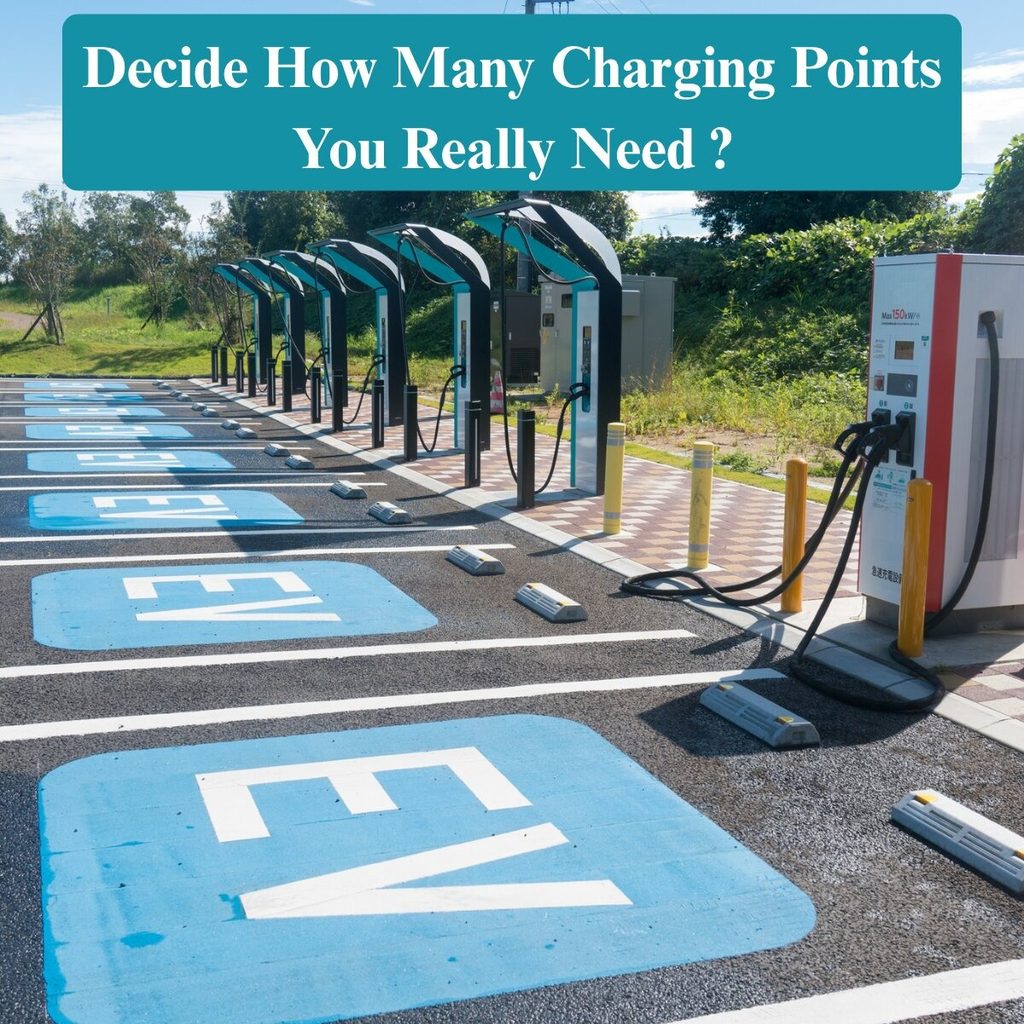
A common assumption is that one powerful charger is better than several smaller ones. That is not always true. Imagine a business has enough capacity for a certain amount of charging power. You could direct most of that electricity into a single charger, or share it out among several stations. The better option depends on what happens in the parking area.
Example: Office
Employees may park for most of the day. Multiple Ac chargers make the setup accessible to more employees, especially since individual vehicles rarely need high-speed charging
Example: Fleet depot
A fleet operator may have several vehicles returning within the same window. Multiple charging points can make it easier to handle those vehicles without depending on one charging position.
Example: Highway site
The situation changes again. A driver stopping on a journey is more likely to care about charging speed and getting back on the road.
So don’t ask only:
How many kW can we install?
Also ask:
How many vehicles should this site be able to serve during its busiest period?
That question can lead to a very different charger layout.
Step- 8 Calculate the Cost of the Whole Project
The charger itself is only one line in the budget.
A commercial installation can include:
- Charging equipment
- Electrical panels
- Cables
- Protection devices
- Installation labour
- Civil work
- Metering
- Networking
- Software
- Payment systems
- Parking modifications
- Signage
- Maintenance
- Replacement components
This is why looking only at the equipment quotation can give you the wrong picture. A charger that costs less initially may require more installation work. Another charger may cost more but include features that reduce the amount of additional equipment required. The right comparison is the total cost of ownership, not just the purchase price.
Ask for these numbers separately
When comparing suppliers ask them to break down:
- Hardware cost
- Installation cost
- Electrical work
- Civil work
- Software charges
- Payment-system charges
- Annual maintenance
- Warranty coverage
- Replacement-part costs
That makes it much easier to compare two different commercial EV charging solutions fairly.
Step- 9 Look at What Happens When the Charger Is Not Working
This question is often forgotten during the buying stage. Everyone talks about charging speed when the equipment is working. A commercial operator also needs to think about what happens when it isn’t. If a charger stops working at an office, employees may complain. At a hotel, a guest may have to find another charging point. At a highway site the issue can directly affect the customer’s journey.
So before buying ask the supplier:
- Is remote monitoring available?
- How are faults reported?
- Can the charger be diagnosed remotely?
- How quickly can technical support respond?
- Are replacement parts available?
- What does the warranty cover?
- Is preventive maintenance available?
- Who will handle software issues?
BEE notes that EVSE can include smart metering and network connectivity, showing why modern charging equipment can involve both physical infrastructure and digital functions.
Step- 10 Think About the Next Few Years Not Just the First Installation
You might install two chargers today and discover that you need six later. If the original installation leaves no room for expansion, adding those chargers could become unnecessarily complicated. Future planning does not mean buying everything on day one. It means leaving a sensible path for growth.
For example, you could consider:
- Space for additional chargers
- Future electrical load
- Cable routes
- Additional parking bays
- Network capacity
- Software scalability
- Load-management capability
This can be especially useful for offices, hotels and fleet operators where EV usage may increase over time.
One High-Power Charger or Several Smaller Ones?
There is no universal answer.
Consider this simple situation:
Option A: One high-power charger serving one vehicle at a time.
Option B: Several charging points allowing multiple vehicles to charge.
If your customers need quick turnaround Option A may fit the operating model. If your users leave their vehicles for several hours, Option B may allow more people to use the facility. The right choice depends on the charging pattern not on which option sounds more advanced.
Five Mistakes That Can Make a Commercial Charging Project Expensive
1. Choosing the charger before studying the site
A product may look perfect until you discover that the building needs electrical upgrades.
2. Buying more power than users can actually use
A higher rating is useful only when the vehicles and business need it.
3. Ignoring the busiest part of the day
Average daily usage can hide the real problem. How many chargers you need is often decided by your busiest charging hours
4. Comparing only charger prices
Two chargers with similar prices can have very different installation, software and maintenance costs.
5. Forgetting what happens after installation
A commercial charging station needs monitoring, servicing and technical support. Buying the equipment isn’t where the project ends.
.
A Practica l Buying Checklist
Before signing off on your EV charging station for business, check the following.
Site
- Parking location selected
- Vehicle movement understood
- Charger location checked
- Cable routes planned
- Electrical assessment completed
Demand
- Daily users estimated
- Peak charging period identified
- Simultaneous charging requirement estimated
- Future demand considered
Equipment
- AC/DC requirement confirmed
- Power rating checked
- Vehicle compatibility confirmed
- Connector requirements confirmed
- Safety requirements reviewed
Commercial side
- Equipment cost calculated
- Installation cost calculated
- Electrical upgrade cost considered
- Software/network costs checked
- Maintenance cost understood
- Warranty reviewed
Long-term use
- Remote monitoring considered
- Service response process confirmed
- Spare-part availability checked
- Expansion path identified
- Future electrical demand considered
Frequently Asked Questions
How do I choose a commercial EV charger?
Start with the property and its users. Look at parking time, number of vehicles, simultaneous charging demand, vehicle compatibility and available electrical capacity. Then choose the charger type and power that fits those conditions.
Is a DC fast charger always better for a commercial property?
No. DC can be useful when vehicles need faster charging, but a location where cars remain parked for several hours may have different requirements. The right charger depends on the site’s actual use.
How many EV chargers does a business need?
There is no fixed number. The answer depends on expected users, peak demand, parking duration and how many vehicles need charging at the same time.
What should I check before installing an EV charger?
Check electrical capacity, charger location, cable routing, protection equipment, vehicle compatibility, parking arrangements, connectivity, installation requirements and future expansion.
What is the difference between charger power and vehicle charging speed?
The charger’s rated output is only one part of the equation. The vehicle’s maximum charging capability and the site’s available electrical capacity can limit the power actually delivered.
Should I choose one powerful charger or multiple chargers?
Look at how your vehicles arrive and how long they stay. A high-power charger may suit quick-turnaround locations, while several charging points can be more useful where vehicles remain parked for longer.
What makes a commercial EV charging setup future-ready?
A future-ready setup leaves room for additional chargers and considers electrical capacity, cable routes, software, networking and changing charging demand.
Final Thoughts
There is no magic number that tells every business which EV charger to buy. The right decision comes from understanding the site first. A hotel, office, fleet depot and highway charging location may all need EV charging, but they do not operate in the same way. Their parking patterns, users, charging times and electrical requirements are different. So start with the vehicles and the property. Work out when charging is actually needed. Check what the electrical system can support. Then compare charger types, power ratings, installation costs, software and service support. That approach makes the commercial EV charger part of a properly planned charging system instead of treating it as a standalone product. For businesses planning commercial EV charging infrastructure in India, taking time to understand the site before purchasing equipment can also make future expansion much easier. If you are planning a commercial charging project, build the requirement first and choose the hardware second.